CBE vs. Private Banks: 2026 Salary & Benefits Guide for Ethiopia
Introduction
For banking professionals and fresh graduates in Ethiopia, the ultimate career dilemma often comes down to one choice: Do you join the state-owned behemoth, the Commercial Bank of Ethiopia (CBE), or do you dive into the highly competitive world of private banks like Awash, Dashen, Bank of Abyssinia, or Wegagen?
In 2026, the Ethiopian banking landscape is undergoing rapid transformation, driven by digital banking targets and the looming entry of foreign banks. To attract top talent, both CBE and private banks have aggressively restructured their compensation packages. This guide breaks down the real financial and career differences between the two paths.
1. Entry-Level Salaries: Who Pays More on Day One?
For fresh graduates hired as Customer Service Officers (CSO) or Management Trainees, the starting salary is usually the first point of comparison.
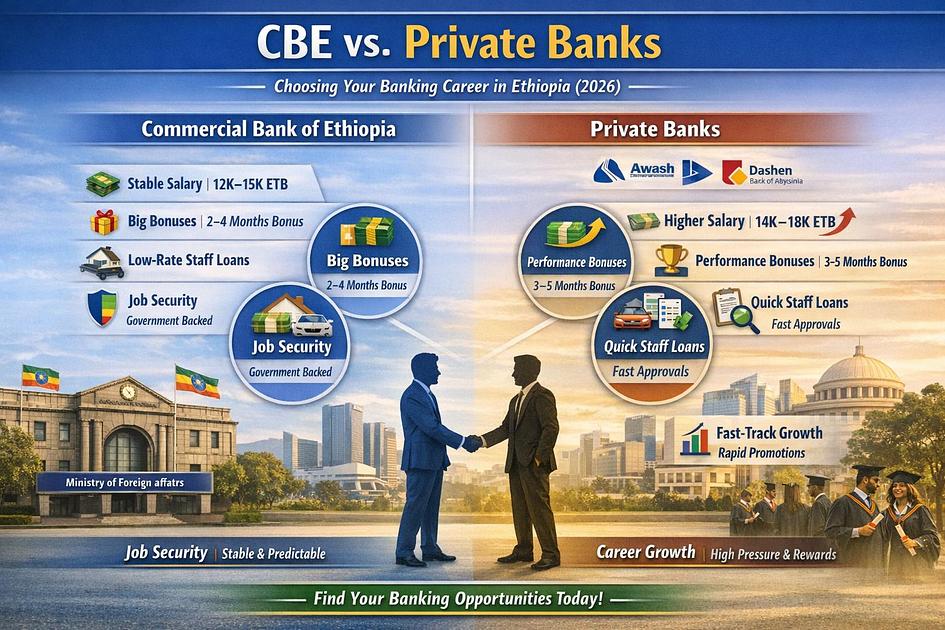
- Private Banks: Historically, top-tier private banks like Awash and Dashen offer a slightly higher basic starting salary to lure the best graduates from Addis Ababa University and regional universities. In 2026, entry-level gross salaries in the private sector typically range between 14,000 ETB and 18,000 ETB, depending on the bank's tier.
- CBE: The Commercial Bank of Ethiopia might offer a base salary that is marginally lower or on par with mid-tier private banks (averaging around 12,000 ETB to 15,000 ETB for junior roles). However, base salary is only a fraction of the CBE story.
2. Allowances: The Hidden Income
In the Ethiopian banking sector, allowances often make up a significant portion of your monthly take-home pay, helping professionals cope with the rising cost of living in Addis Ababa and regional capitals.
- Housing and Transport: Both CBE and private banks offer housing and transport allowances. Private banks often adjust these allowances more frequently to match inflation.
- Representation Allowance: For Branch Managers and District Directors, private banks are known to offer highly competitive representation and fuel allowances to ensure their managers can effectively network and bring in high-net-worth clients.
3. The Bonus Structure: Where the Real Money Is
This is where the debate heats up. Annual bonuses are deeply embedded in Ethiopian banking culture, usually paid out around the Ethiopian New Year (Enkutatash) or after the annual financial audit.
- The CBE Advantage: CBE is famous for its generous bonus payouts. Because of its massive market share and profitability, CBE employees historically enjoy bonuses that can equal several months of their basic salary. It is highly structured and generally reliable.
- The Private Sector Hustle: Private banks operate on a strict performance-based model. If a private bank hits its annual targets, the bonuses can be staggering—sometimes up to 3 to 5 months' basic salary. However, if the bank underperforms or faces a liquidity crunch, bonuses can be quickly scaled back.
4. Staff Loans: Mortgages and Cars
Access to credit is one of the primary reasons professionals choose a lifelong career in banking in Ethiopia.
- CBE: The state bank provides highly reliable staff loan facilities, including long-term housing mortgages and car loans at heavily subsidized interest rates. The internal policies are strict, but the sheer size of the bank means the lending pool is vast.
- Private Banks: Private banks have become incredibly aggressive with staff loans to retain talent. Many offer "emergency loans," personal loans, and car loans with faster approval times than CBE. For high-performing branch managers, access to vehicle loans is a major retention tool.
5. Job Security vs. Career Progression
Your personality and risk tolerance should dictate your choice here.
- Job Security (CBE): Working for the Commercial Bank of Ethiopia is practically a government job. Job security is unmatched. The work environment is structured, unionized, and heavily regulated. However, because of its massive workforce, climbing the corporate ladder to become a Branch Manager or Director can take many years of patient service.
- Fast-Track Growth (Private Banks): Private banks are a meritocracy. If you are aggressive, excellent at "Deposit Mobilization" (bringing in new money), and can hit your targets, you can be promoted from a CSO to a Branch Manager in a fraction of the time it would take at CBE. The trade-off is high pressure, strict targets, and a high-stress environment.
6. The Verdict: Which Should You Choose?
- Choose CBE if: You value long-term stability, predictable hours, robust union protection, reliable housing loans, and a structured, massive institutional environment.
- Choose Private Banks if: You are highly ambitious, thrive under target-driven pressure, want faster promotions, and prefer a modern, aggressive corporate culture where your sales skills directly impact your income.
Ready to Start Your Banking Career?
Whether you are aiming for CBE or a private bank, the first step is knowing when they are hiring.
- Make sure your CV is updated.
- Prepare for the rigorous entrance exams.
- Browse the latest banking vacancies across Ethiopia right here on our Banking & Finance job category