Career Opportunities in Ethiopia’s Interest-Free Banking (IFB) Sector: 2026 Guide
Introduction
Interest-Free Banking (IFB) is no longer a "side service" in Ethiopia; it is a primary driver of financial inclusion in 2026. Since the National Bank of Ethiopia (NBE) authorized full-fledged interest-free banks, the sector has exploded, creating thousands of specialized jobs. Whether you are a fresh graduate or a seasoned banker looking to pivot, the IFB sector offers a unique career path that combines modern financial principles with ethical, Sharia-compliant values.
1. The Landscape: Full-Fledged Banks vs. IFB Windows
In the Ethiopian market, you have two main types of employers in this sector:
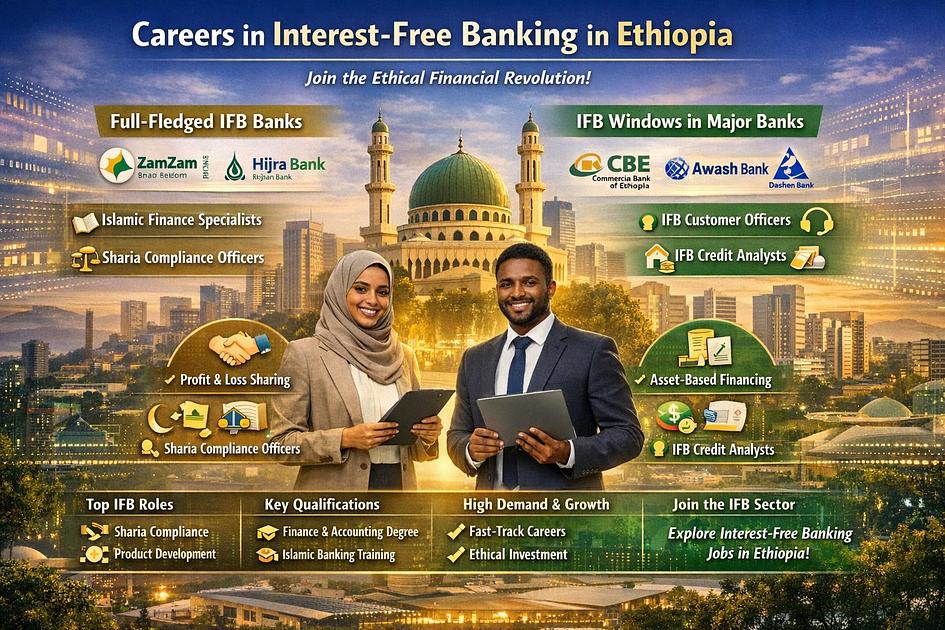
- Full-Fledged IFB Banks: Institutions like ZamZam Bank, Hijra Bank, and Rammis Bank operate entirely on interest-free principles. They are often looking for "pioneers" who can help build their brand from the ground up.
- IFB Windows: Major players like the Commercial Bank of Ethiopia (CBE), Awash Bank, and Dashen Bank have massive interest-free departments. Working here offers the stability of a large institution with the specialized focus of IFB.
2. Most In-Demand IFB Roles in 2026
Recruitment in this sector is specialized. The most sought-after positions include:
- IFB Customer Service Officers (CSO): The frontline of the bank. You must be able to explain complex products like Mudarabah (profit-sharing) and Murabaha (cost-plus financing) to everyday customers.
- Sharia Compliance Officers: These professionals ensure that every product and transaction follows the principles of Islamic finance. This is a high-authority role that often requires a mix of legal and financial knowledge.
- IFB Credit Analysts: Unlike traditional credit roles, these analysts focus on asset-backed financing and profit-sharing ratios rather than interest rates.
- Product Development Specialists: As the market matures, banks are competing to create new Sharia-compliant products for mortgages, car loans, and business financing.
3. Do You Need a Specific Degree?
A common misconception is that you need a religious degree to work in IFB. In reality:
- Educational Background: Most banks require standard degrees in Accounting, Finance, Economics, or Management.
- The Competitive Edge: Having a certification in Islamic Finance (such as from AAOIFI) or having taken elective courses in Sharia-compliant banking will put you ahead of 90% of other applicants.
- Internal Training: Most Ethiopian banks provide intensive internal training for new hires to bridge the gap between traditional accounting and IFB principles.
4. Why Choose a Career in IFB?
- High Growth Potential: As the newest sector in Ethiopian banking, the "ladder" is shorter. Talented professionals can move into management roles faster than in traditional departments.
- Ethical Alignment: Many professionals find a higher level of job satisfaction working in a system that avoids Riba (usury) and focuses on ethical investment.
- Market Demand: There is currently a shortage of experienced IFB professionals in Ethiopia. Once you have 2–3 years of experience in an IFB department, you become a "highly hunted" talent for other banks.
5. Interview Tips for IFB Roles
When interviewing for an IFB position at a bank like Hijra or ZamZam, expect these specific questions:
- "Can you explain the difference between a loan and a financing agreement in IFB?"
- "How would you explain the concept of 'Profit and Loss Sharing' to a customer used to fixed interest?"
- "Why is it important for the bank to avoid investing in certain prohibited industries?"
Conclusion: The Future is Interest-Free
With Ethiopia’s large and underserved population, the IFB sector is predicted to grow by double digits every year for the next decade. For job seekers, this represents one of the most stable and rewarding career moves available in 2026.
Ready to join a leading IFB institution? Browse the latest Interest-Free Banking vacancies in Ethiopia on our specialized job board today!