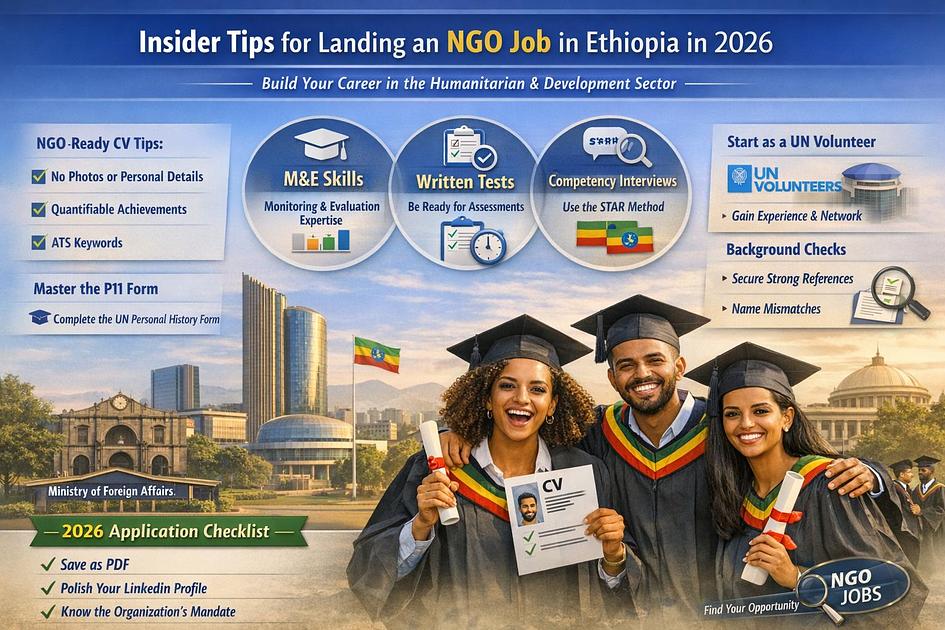
How to Get Hired by an NGO in Ethiopia: 2026 Insider Tips
Introduction
Addis Ababa is not just the capital of Ethiopia; it is the diplomatic capital of Africa. Hosting the African Union (AU), the United Nations Economic Commission for Africa (UNECA), and hundreds of international Non-Governmental Organizations (NGOs), the city offers unparalleled opportunities in the development and humanitarian sectors. However, the recruitment process for these organizations is vastly different from local corporate hiring. It is rigorous, highly structured, and strictly merit-based. Here are the insider tips for landing an NGO job in Ethiopia in 2026.
1. The "NGO-Ready" CV vs. The Traditional CV
If you are sending the same CV to the Commercial Bank of Ethiopia and the World Food Programme (WFP), you will likely be rejected by the latter.
- The Rule: International NGOs use Applicant Tracking Systems (ATS). Drop the photograph, your age, your religion, and your marital status—these can actually disqualify you due to international anti-discrimination policies. Focus purely on professional competencies, quantifiable achievements, and exact dates of employment.
2. Navigating the P11 Form and UN Inspira
For UN agencies, your CV is often secondary to the Personal History Form (P11) or the digital equivalent on the Inspira portal.
- The Strategy: The P11 form requires extreme detail. Do not leave gaps in your employment history. When describing your duties, use the exact keywords found in the "Terms of Reference" (TOR) or job description. If the job asks for "capacity building," use that exact phrase in your work history.
3. The Golden Ticket: Monitoring and Evaluation (M&E)
In 2026, the most sought-after skill in the Ethiopian development sector is not project management—it is Monitoring, Evaluation, Accountability, and Learning (MEAL / M&E).
- Why it matters: Donors demand strict reporting on how funds are used. If you can demonstrate skills in data collection, logframes, and impact assessment (even through a short online certificate), your application will immediately jump to the top of the pile.
4. The Hidden Hurdle: The Written Assessment
Most major NGOs (like Save the Children, IRC, or World Vision) require candidates to pass a timed written test before they are even invited to an interview.
- What to expect: You might be given a case study about a supply chain disruption in the Tigray or Somali region and asked to draft a response plan within 60 minutes. The assessors are testing your technical knowledge, your ability to work under pressure, and your written English proficiency.
5. Mastering the Competency-Based Interview (CBI)
NGOs do not ask generic questions like "What are your weaknesses?" They use Competency-Based Interviews, meaning they want real-life examples of your past behavior.
-
The STAR Method: You must answer using this framework:
- Situation: Set the scene.
- Task: What was your responsibility?
- Action: What specific steps did you take?
- Result: What was the measurable outcome?
- Example Question: "Tell us about a time you had to deliver a project with a shrinking budget."
6. Language Skills for Field Work
While English is the working language for international NGOs in Addis Ababa, operations in the field require local expertise.
- The Advantage: Fluency in Amharic is standard, but professional proficiency in Afaan Oromoo, Tigrinya, or Somali makes you an invaluable asset for field coordination roles. If you speak French, you are highly competitive for AU-affiliated roles.
7. United Nations Volunteers (UNV): The Best Stepping Stone
Many professionals ignore the UNV program because of the word "volunteer." This is a mistake.
- The Reality: UNVs receive a highly competitive monthly living allowance (often higher than mid-level private sector salaries in ETB), full medical insurance, and direct internal access to UN networking. It is the most reliable backdoor into a permanent UN staff position.
8. Navigating Background Checks and References
Integrity is non-negotiable in the humanitarian sector.
- The Standard: You will need at least three professional references (usually your direct supervisors, not colleagues or professors). NGOs will contact them. Ensure your references are aware you are applying and that the contact details you provide are up-to-date.
9. Patience is a Virtue (The Timeline)
The private sector in Ethiopia might hire you in two weeks. An international NGO might take three to six months.
- The Advice: The process includes longlisting, shortlisting, written exams, panel interviews, and headquarters approval. Do not resign from your current job just because an NGO interview "went well." Wait for the official offer letter.
2026 Application Checklist
- Save as PDF: Never send your CV or cover letter as a Word document. Always export to PDF to preserve your formatting.
- Clean Digital Footprint: NGO HR departments will check your LinkedIn profile. Ensure it perfectly matches the dates and titles on your P11 form.
- Read the Mandate: Know the difference between UNICEF (children) and UNHCR (refugees) before you walk into the interview room.